
A Cash Flow Machine Trading at a Discount
Salesforce (CRM) kicked off 2026 with a surprisingly strong earnings report that silenced many critics. We looked at the numbers, and the company delivered a record $10.3 billion in quarterly revenue, marking a solid 9.00% increase from the previous year. Even better, their non-GAAP EPS hit $3.25, largely because their new AI bets are paying off faster than expected. Products like "Agentforce" and Data 360 have already generated $1.4 billion in annual recurring revenue. We also noticed that management has gotten serious about efficiency, pushing operating margins up to 35.50%. The only real blemish on the report was in the Professional Services segment, where revenue dipped to $533 million as companies started spending more budget on autonomous software rather than hiring human consultants to manage their systems.
Business Analysis
Grade: B
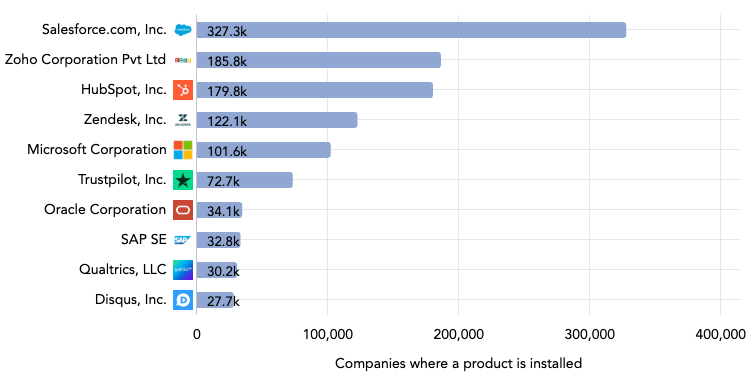
When we dig into the business itself, which earned a B grade in our analysis, Salesforce is still the undisputed heavyweight champion of the CRM world, controlling between 21.70% and 26.00% of the market. The business is built on the Customer 360 platform, which bundles all their different tools together. The core revenue drivers remain the Sales Cloud and Service Cloud, which act as the digital backbone for sales teams and customer support agents worldwide. However, the real story right now is how they are using the Data Cloud to modernize these older products. By connecting all a company's data into one place, Salesforce is positioning itself not just as a database, but as the "brain" of the enterprise where AI agents can live and work.
When we look at where the money actually comes from, we see a really healthy mix that you rarely find in tech. Unlike some companies that live and die by one "hero" product, Salesforce has its revenue split incredibly evenly. Service Cloud is the biggest chunk at $9.05 billion, but Sales Cloud is right behind it with $8.32 billion, and the Platform business isn't far off either at $7.25 billion. Even the smaller segments like Marketing & Commerce ($5.28B) are pulling their weight. This balance is great because it creates real stability; if one area has a slow quarter, the others can pick up the slack.

Geographically, however, it’s a different story. They are still heavily reliant on the Americas, which brought in $25.14 billion—about 66% of their total sales. While some might see that concentration as a risk, we actually see it as a massive opportunity. With Europe and Asia Pacific combining for only about $12.75 billion, there is a huge runway left to expand into international markets, giving them plenty of open space to keep growing outside of the US.

Fundamental Analysis
Grade: A
Moving on to the fundamentals, this is where the stock really shines, earning a perfect A grade in our 9 Pillar Analysis. Salesforce has turned into an absolute cash machine over the last decade. Their revenue has grown at a very steady 10-year CAGR of 21.57%, climbing from roughly $6.67 billion in 2016 to over $37.89 billion in 2025. But what is even more impressive is how efficient they have become at turning that revenue into cash. The 10-year Free Cash Flow (FCF) CAGR is sitting at 32.30%, which means their cash generation is growing significantly faster than their sales. To put that in perspective, their total free cash flow has exploded by 1,542.92% over the last ten years.

Management is using this mountain of cash to reward shareholders aggressively. They have authorized a massive $50 billion buyback program, which has already reduced the share count from 988 million in 2023 down to 955 million today. They also introduced a dividend recently, and because their FCF payout ratio is so low, at only 12.87% in 2025, that dividend is incredibly safe and has plenty of room to grow.
Intrinsic Value Analysis
Grade: B
Finally, we have to look at the valuation, which receives a B grade. It looks very attractive compared to historical norms. For years, investors had to pay a premium for Salesforce, with a 5-year adjusted average PE ratio of 55 - 60. Today, however, the forward PE is trading at a modest 15.18. Analysts expect the company to keep growing earnings at a healthy pace, projecting a 5-year future EPS CAGR of 15.45%. When you combine that growth rate with the current price, you get a PEG ratio of 1.12. In the investing world, a PEG near 1.0 usually signals that a stock is undervalued relative to its growth potential.

We ran the numbers through our own intrinsic value models, including a Discounted Cash Flow analysis, and arrived at a fair value of $242.45 per share. With the stock currently trading at $199.44, that gives investors a nice margin of safety of 21.57%. Wall Street seems to agree with us, as 44 out of 58 analysts currently have a "Buy" rating on the stock, with an average price target of $324.17, implying a potential upside of over 60%.
Conclusion
In conclusion, Salesforce has successfully transitioned from a high-growth disruptor into a profitable, cash-generating giant. The fundamentals are rock solid (Grade A), driven by that incredible 32.30% FCF CAGR and a smart capital allocation strategy. While there might be some risks in the business regarding competition (Grade B), the current valuation offers a rare opportunity to buy a dominant tech leader at a discount (Intrinsic Value Grade B). With a PEG ratio of just 1.12 and a forward PE of 15, our final recommendation is a BUY, as we believe CRM is significantly undervalued and poised for strong returns in 2026.